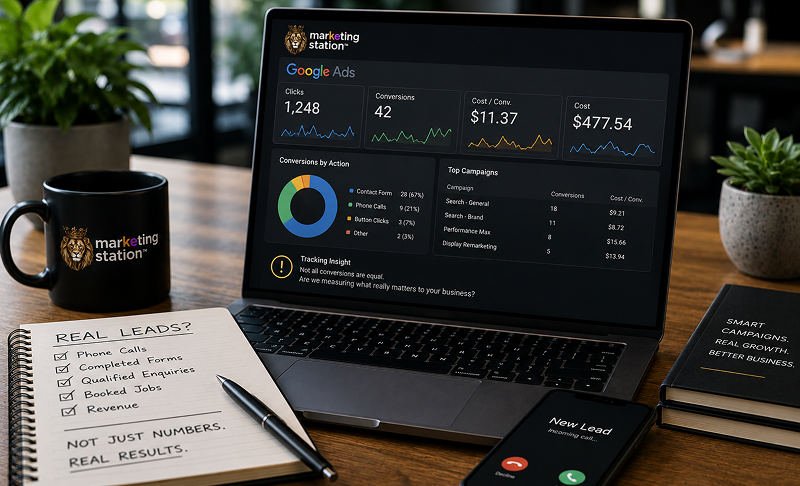
Forty-two conversions.
Excellent.
Except nobody remembers receiving 42 enquiries.
There weren’t 42 calls.
There certainly weren’t 42 sales.
So what exactly did Google count?
Welcome to one of our favourite digital marketing rabbit holes:
The conversion that isn’t actually a conversion.
First, what has Google been told to count?
Google Ads doesn’t inherently know what your business considers valuable.
You tell it.
Or your tracking setup tells it.
That distinction matters.
We’ve seen businesses count:
contact-page views,
button clicks that never became calls,
multiple events from the same enquiry,
form starts rather than form completions,
and other actions that look impressive in a dashboard but don’t put a single new customer into the business.
Marketing Station’s own FAQ emphasises correctly configuring GA4 and Google Ads conversion tracking because campaigns can only optimise effectively when the conversion actions actually represent something valuable.
A conversion is not automatically a lead
This sounds obvious.
Reporting can make it surprisingly easy to forget.
Suppose somebody:
clicks your ad,
visits the website,
clicks the phone number twice,
opens the contact page,
downloads a brochure,
then submits one enquiry.
Depending on the tracking configuration, your reporting could potentially show several actions.
Your sales team received one lead.
That doesn’t mean analytics is useless.
It means we need to understand exactly what we’re measuring.
Campaign structure matters too
Even perfect tracking won’t rescue a badly structured campaign.
Search intent matters.
Someone searching:
“how much does a swimming pool cost?”
is at a different stage from:
“concrete pool builder Penrith quote”
Both searches may be relevant.
They’re not equally valuable.
Marketing Station structures Google Ads around intent and separates research behaviour from stronger commercial searches where appropriate. Our existing Google Ads content also stresses the importance of campaign structure, relevant landing pages and conversion measurement.
Look beyond cost per click
A cheap click that never becomes a customer isn’t particularly cheap.
A more expensive click that turns into a $20,000 project may be extremely valuable.
That’s why obsessing over CPC in isolation can send a campaign in completely the wrong direction.
We care about what happens after the click.
Did they call?
Did they submit?
Was it a genuine enquiry?
Was the enquiry relevant?
Did it become a sale?
What was that customer worth?
Now we’re discussing marketing rather than merely advertising.
The sales team knows things Google doesn’t
This is one of the most underused sources of campaign intelligence.
Ask the person answering the phone.
Which leads were good?
Which were rubbish?
What were people asking for?
Which service generated the best enquiry?
Were people outside the service area?
Did they misunderstand the offer?
Did three excellent leads turn into jobs?
That information should make its way back into campaign decisions.
Otherwise the advertising team is optimising from a dashboard while ignoring the humans actually speaking to customers.
Landing pages matter
The ad can be perfect.
Then the customer arrives on a page that talks vaguely about the entire business.
They searched for emergency electrical repairs.
The landing page opens with the history of the company.
They searched for a funeral home in their suburb.
The page makes them hunt through a location menu.
They searched for pool renovations.
The page talks primarily about new pools.
That disconnect costs leads.
The promise in the advertisement and the information on the page should belong to the same conversation.
Don’t blindly accept every recommendation
Google provides plenty of automated recommendations.
Some are useful.
Some deserve scrutiny.
Marketing Station has been making this point for years: campaign decisions should be based on the business objective, search intent and actual performance rather than automatically applying every recommendation presented by the platform.
Automation is powerful.
Supervision remains rather handy.
The dashboard isn’t the business
This is the principle we keep coming back to.
Google Ads is not successful because the graph went up.
It’s successful when it contributes to the outcome the business actually needs.
Calls.
Bookings.
Quotes.
Sales.
Revenue.
Good customers.
Forty-two conversions look wonderful.
We’d still rather have twelve genuine enquiries that turn into six profitable customers.
Frequently Asked Questions
Why does Google Ads show more conversions than leads?
Tracking may be counting actions that aren’t unique enquiries, or multiple conversion actions may be attributed to one user journey.
What should a Google Ads conversion be?
That depends on the business, but calls, completed enquiry forms, bookings or purchases are common primary conversion actions.
Can Marketing Station audit Google Ads conversion tracking?
Yes. Marketing Station works with Google Ads, GA4 and conversion tracking as part of its advertising and measurement services.
Should GA4 be linked with Google Ads?
Yes, when configured correctly. Marketing Station notes that this improves reporting and campaign optimisation.
Why am I getting irrelevant Google Ads enquiries?
Potential causes include keyword targeting, match types, location settings, search intent, negative keywords or landing-page messaging.
Should I apply all Google Ads recommendations?
No. Recommendations should be assessed against your actual campaign strategy and business objectives.
Does Marketing Station manage Google Ads in Sydney?
Yes. Google Ads management is one of Marketing Station’s core advertising services.
Does Marketing Station work outside Sydney?
Yes. Marketing Station works with businesses across Australia and New Zealand.