Every few years, SEO apparently passes away.
Social media killed it.
Voice search killed it.
Google Ads killed it.
TikTok killed it.
AI has now been handed the shovel.
And yet businesses still need to be found when people are looking for what they sell.
So perhaps SEO isn’t dead.
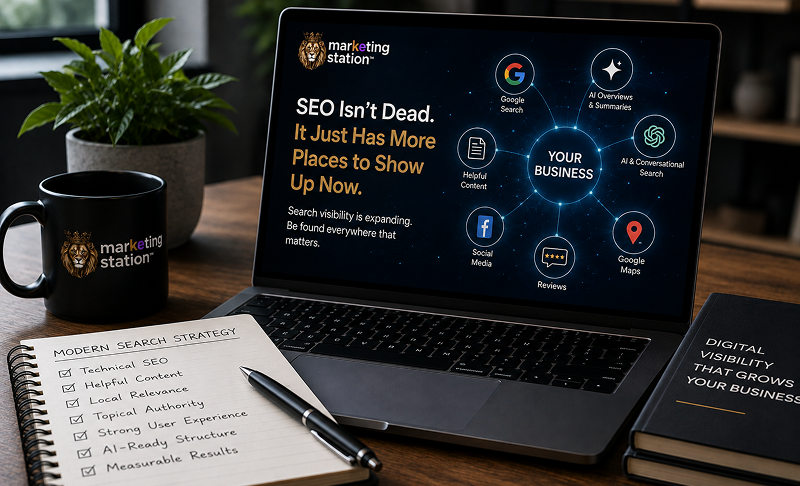
Perhaps search has simply become bigger than Google rankings.
What does “search” mean now?
A customer might discover a business through:
Google Search.
Google Maps.
An AI-generated summary.
A conversational AI platform.
A social platform.
A review.
A recommendation.
An article.
A local result.
Then they might visit the website, check reviews, return to Google, ask AI another question and finally call.
Discovery is no longer a beautifully tidy straight line.
It’s spaghetti.
Useful spaghetti, but spaghetti nonetheless.
Marketing Station’s current approach reflects this by designing digital systems for visibility across Google, AI search, social and owned channels rather than treating each platform as an isolated island.
Rankings still matter
Let’s not throw the baby out with the algorithm.
Traditional organic visibility remains valuable.
If someone searches for the exact service you provide in the exact location you serve, appearing prominently matters.
Technical SEO matters.
Page structure matters.
Internal linking matters.
Local relevance matters.
Content matters.
Authority matters.
But ranking is now one part of a broader visibility strategy.
AI changes the type of query
People can now ask much richer questions.
Not simply:
“SEO agency Sydney.”
But:
“My website traffic hasn’t dropped but enquiries have. What should I check?”
That’s an entirely different search experience.
Interestingly, it also creates an enormous opportunity for businesses with genuine expertise.
Because if your website has already published a clear, credible explanation answering that problem, you’ve created something potentially useful to both people and machines.
This is why Marketing Station’s content strategy focuses on answering real questions rather than publishing content merely to satisfy a keyword target.
Your expertise needs to exist online
Your business may know an extraordinary amount.
The problem is that most of that knowledge lives inside people’s heads.
Your mechanic knows the five warning signs customers ignore before a major repair.
Your funeral director knows the questions families are frightened to ask.
Your builder knows what causes project delays.
Your dentist answers the same nervous questions every Tuesday.
Your sales team knows exactly why customers choose option B instead of option A.
That’s valuable information.
If none of it exists on your website, search engines and AI systems can’t magically interview your staff.
Content turns internal expertise into discoverable expertise.
Structured doesn’t mean robotic
One mistake businesses make with SEO is writing for machines.
Keyword.
Keyword again.
Suburb.
Keyword.
Nearby suburb.
Keyword wearing a fake moustache.
Nobody wants to read that.
Good modern search content should be exceptionally clear without sounding manufactured.
Use useful headings.
Answer the question directly.
Provide detail.
Use natural terminology.
Explain geography where relevant.
Connect related topics.
Make it easy to navigate.
Humans appreciate clarity.
Machines do too.
Local search deserves its own strategy
For businesses serving particular regions, visibility isn’t merely national or industry-wide.
It’s geographic.
A business might need visibility across:
Sydney,
Newcastle,
the Hunter Valley,
Western Sydney,
or specific suburbs surrounding a physical location.
Marketing Station distinguishes between broader SEO and local SEO, with local strategy targeting map visibility and location-intent searches.
That means understanding not merely what the business does but where it genuinely does it.
AI should support the strategy, not become the strategy
We use AI at Marketing Station.
Quite a lot, actually.
For research.
Analysis.
Ideation.
Efficiency.
Creative exploration.
Pattern recognition.
But our website deliberately describes our approach as human-led, AI-enabled.
That’s an important distinction.
AI can accelerate work.
It cannot replace understanding the client’s business, market, customer, commercial objectives and brand.
Otherwise you simply produce more stuff faster.
The internet already has plenty of stuff.
So what should businesses do now?
Don’t panic.
Don’t rename your entire SEO strategy GEO because somebody on LinkedIn told you to.
And don’t abandon Google because AI exists.
Build stronger digital foundations.
Make your services unmistakably clear.
Improve your technical structure.
Develop meaningful local relevance.
Publish genuinely useful expertise.
Strengthen trust signals.
Connect your content.
Measure what customers actually do.
Then keep refining.
Search isn’t disappearing.
It’s spreading.
And businesses that become genuinely useful sources of information have more places than ever to be discovered.
Frequently Asked Questions
Is SEO dead because of AI?
No. Search behaviour is evolving, but businesses still need strong technical foundations, useful content, authority and clear information to be discovered.
What is AI search optimisation?
It involves structuring and strengthening digital information so a business can be better understood across AI-powered search and discovery experiences as well as traditional search.
Is AI SEO different from normal SEO?
There are additional considerations, but many core principles overlap, including structure, authority, relevance, technical quality and useful content.
Does Marketing Station provide SEO in Sydney?
Yes. Marketing Station provides SEO, local search and AI-ready search strategy.
Does Marketing Station provide SEO in Newcastle and the Hunter Valley?
Marketing Station works with businesses across Australia and New Zealand and has historically serviced Sydney, Newcastle and the Hunter region.
What is local SEO?
Local SEO focuses on visibility for geographically relevant searches and map results, such as service-plus-location and “near me” searches.
Do businesses still need helpful articles?
Yes. Useful articles can answer genuine customer questions, demonstrate expertise and build topical relevance around core services.
Can Marketing Station review our current SEO and AI visibility?
Yes. The starting point is understanding the website, services, service areas and desired business outcomes before recommending the appropriate strategy.